There is a particular kind of silence that settles over a house when the power goes out. The fridge stops humming. The Wi-Fi disappears. The lights become useless ornaments. Somewhere down the street, a generator rumbles to life.
But in West Monroe, Louisiana, during a recent multi-day blackout, Keith McGrew had a different experience. As his neighbors searched for gasoline to keep their generators running, McGrew used his EV to power almost all of his home. By the third day, according to Bloomberg, he even had enough electricity to use the oven.
It’s an image that cuts through years of complicated energy talk: a vehicle in the driveway, keeping a house alive. But McGrew was using his vehicle as a generator, minus the gasoline. That only works as a shield for days when emergency strikes. And that's only the beginning of what an EV can do to reshape your home energy every other day of the year.
This is a great scenario to understand the power of bidirectional charging. When the grid goes down, your EV can send power back into your home. Depending on make and model, a fully charged EV can provide full-home power for up to 2.5 days, or as long as 10 days if power is rationed at 30 kWh/day usage.
If your home also has solar, the equation changes again: during the day, rooftop power can keep critical loads running in a blackout even when your car is not in the driveway, and recharge the EV when you get back home.
But backup power is only the beginning. The bigger story is what happens on ordinary days when there’s no storm, no blackout, and no emergency alert on your phone. Your EV is more than just a way to get around. When the car is connected to the right home energy system, it becomes part of the daily rhythm of your house: charging when electricity is cheaper, holding power in reserve when you need security, and helping your home avoid the most expensive hours automatically. With solar in the mix, the reserve is no longer static — you can charge your car with the light of the sun during the day, adding free energy to your pool of backup power.
That’s the easiest way to understand bidirectional charging. But translating that into something everyone immediately grasps is still a challenge. “Most people already understand a phone power bank,” says Polestar North America Product Manager Eric Buchka. “This is the same idea, at the scale of a home.”
Why homeowners are rethinking energy now
EVs are arriving at a moment when homeowners are being asked to think about energy in new ways. Blackouts are more common in many regions. Electricity rates are more complicated. More homes have solar panels, backup batteries, smart thermostats and EV chargers, each making its own demands on the household.
Most people do not want to manage all of that. They want the lights to stay on, the car to be ready in the morning and the bill to make sense.
V2H, V2G, V2L: the directions your energy can travel
In a conventional EV charger, electricity flows one way: from the grid to the car. With bidirectional charging, energy can move in both directions. Vehicle-to-home, or V2H, means the car can power the house. Vehicle-to-grid, or V2G, means it can send electricity back to the grid, usually through a utility program. Vehicle-to-load, or V2L, means it can power devices directly, like tools at a worksite or a fridge at a campsite. Add solar and the flow is no longer just grid-to-car or car-to-home: it can move straight from the roof to the car, or from the car to the home, and from the roof to your home during an outage.
For the homeowner, the distinction matters less than the result. As Sammy Nelson, Head of Product at dcbel, puts it: “Vehicle-to-home can be understood more simply as powering your home with your car.” When the power is out, your car keeps the essentials running. When rates are high, your home can use stored energy instead of buying expensive electricity from the grid. If solar is available, that same stored energy can be replenished by the sun instead of purchased from the grid, making your car part of a larger, renewable reserve.
More cars can do this than you'd expect
The number of cars that can do this is growing. Bloomberg estimates that American drivers now own more than 600,000 EVs that can serve as emergency power sources. The International Energy Agency says the number of models with V2G capability has grown rapidly over the past two years.
Automakers themselves are beginning to rethink what the car represents once it’s parked and plugged in.“Your car is idle at the office or idle in your driveway for most of the day. It's still a car first. But the driveway hours are hours we can put to work for customers,” says Buchka.
So what is your EV actually saying when it plugs in?
From the homeowner’s perspective, not much. And that’s the point. Nelson says the message is simple: the EV is saying it is ready. More specifically: “I’m ready to start.”
Behind that simple message is a quiet exchange between the vehicle, the charger, the home and the grid. The system needs to know what is connected, whether the grid is available, how much energy the car has, how much power it can safely supply and whether the home should draw from the car now or save that energy for later.
But none of that should feel like homework. “This communication is essential,” says Nelson, “but it should not be visible or require interpretation by the customer.”
That’s the key difference between a clever feature and a useful one. A bidirectional EV should not ask you to become an amateur energy manager. You should not have to watch the wholesale electricity market or decide whether your fridge or your commute is more important. The system should make those decisions in the background, based on the priorities you set.
And in many cases, even those priorities can be simple. Maybe you want to set a minimum driving range. Maybe you want the car ready by 7:30 every morning. You may want a backup reserve in case the weather looks bad. Nelson says these controls should always be available, but they should not become another daily chore. A good system should start with sensible defaults, learn from your habits and adjust over time. It can also decide how much solar production should be saved for the evening, how much should go into the EV and how much reserve should be protected for the next trip or the next outage.
Your EV is much bigger than you think
Nelson notes that an EV battery can have four to 15 times the storage capacity of a typical home battery. Even a partially charged car can be a meaningful source of energy for the home.
Imagine coming home with a 60 kWh EV battery at 40%. That leaves 24 kWh in the car. If the system keeps 20% as a safety reserve for driving, there could still be 12 kWh available for the home. At a modest household load, that could mean 5 to 8 hours of support during an outage or a way to avoid drawing from the grid during the most expensive part of the day.
So when the power goes out, your home can keep the essentials running. When peak rates begin, your home can avoid the most expensive hours. When solar panels are producing more than you need, your car can store that energy for later. When you wake up, the car is still ready to drive. The homeowner’s role remains refreshingly ordinary: plug in when you get home and carry on. That matters because the battery is not a fixed emergency tank: on sunny days, it can keep being refilled, which means more reserved energy at home and more miles driven without buying fuel. If the car is away when the grid fails, solar can still support the home directly until the EV returns.
Putting range anxiety to rest
Nobody wants to wonder whether the house drained the car before an important morning drive. Nelson says that anxiety comes from “a lack of visibility, preparedness and trust.” A smart home energy system reduces that uncertainty by understanding driving patterns, tracking home energy use and protecting the range the driver needs.
The goal is not to make homeowners think more about energy. It is to help them think about it less.
The truth about degradation, warranty and cost
There are other worries too. Battery degradation. Warranty coverage. Cost. Complexity. Nelson says many of these misconceptions come from treating the EV and charger as isolated products, rather than as parts of a coordinated home energy setup. Battery concerns are often overstated, he notes, because the energy used to support a home is typically much less demanding than driving, fast charging or regenerative braking. And as automakers build bidirectional capability into more vehicles, it is increasingly being treated as part of normal vehicle operation when used within certified systems.
Buchka says the most common concern he hears from owners considering a bidirectional setup is that they'll wake up without the range they need for their commute. That's because people still picture the car and the charger as "two separate gadgets to monitor," he says. "In practice it's one system. You tell it how much range you want in the morning, and it works around that."
Cost is a real consideration, and homeowners should understand what equipment and installation are required. But the value is also broader than a single emergency. Backup power can help avoid spoiled food, frozen pipes, hotel stays or lost work during an outage. Smarter charging can reduce exposure to peak rates. In some places, grid programs may eventually reward homeowners for making a small portion of their EV battery available when demand is high. Solar changes the economics too: every kilowatt-hour stored from the roof is one you don’t have to buy from the grid, and every solar-charged mile is a mile you’ve driven without paying for gasoline or public charging.
The next wave of EV ownership
The first wave of EV adoption was about replacing the gas tank with a battery. The next wave is about realizing what that battery can do when the car is parked, plugged in, and connected to the home.
"Fast charging was a differentiator once. Now it's an expectation," says Buchka. "We think bidirectional goes the same way. Within a few years people won't ask if a car can power the house, they'll assume it does, and they'll notice when it can't."
That does not mean homeowners need another dashboard to check. It does not mean they need to understand every acronym. It means the car in the driveway can become part of the home’s energy life, quietly helping when the grid is down, when rates are high or when stored solar power can be put to better use.
How Ara brings it all together
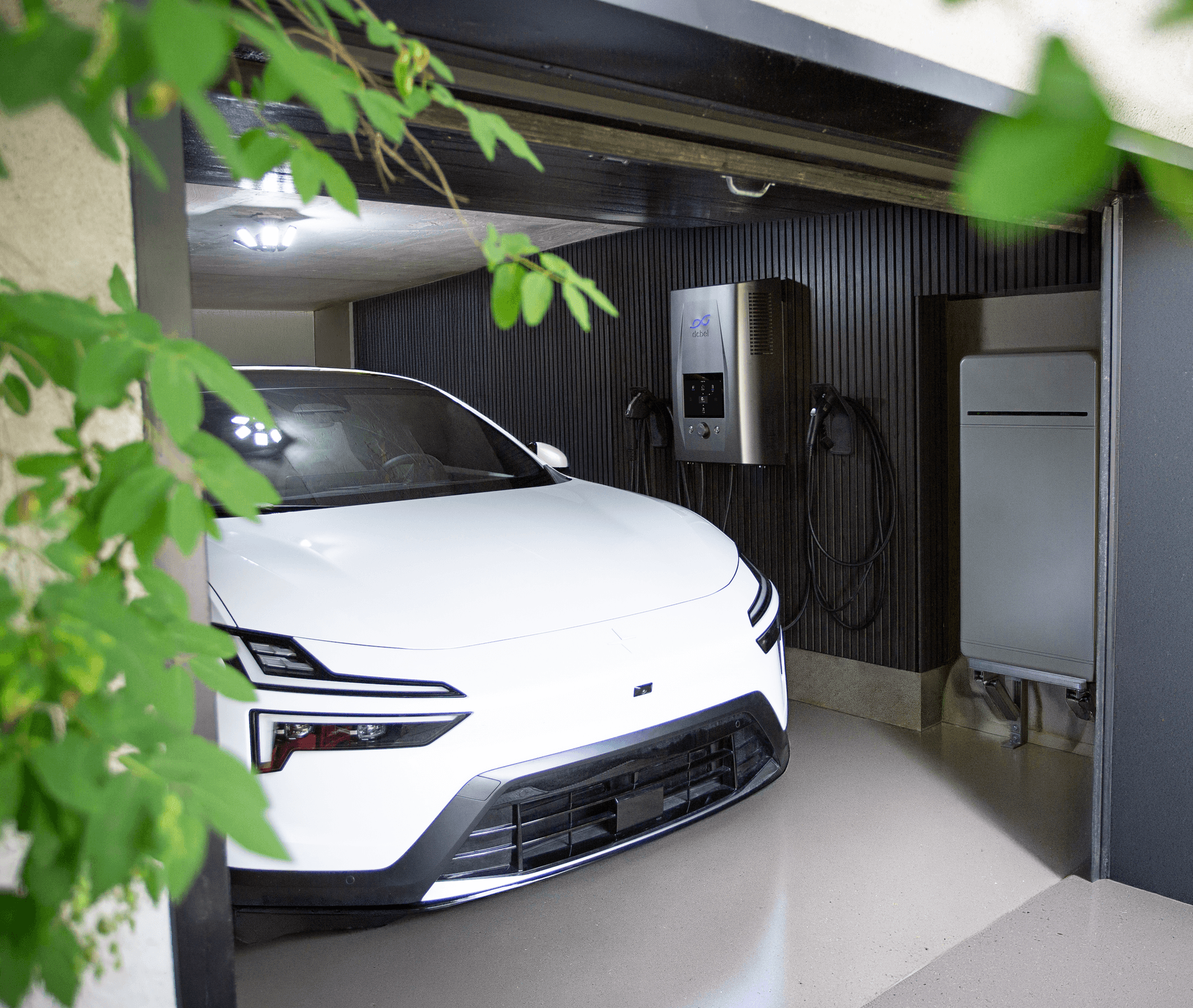
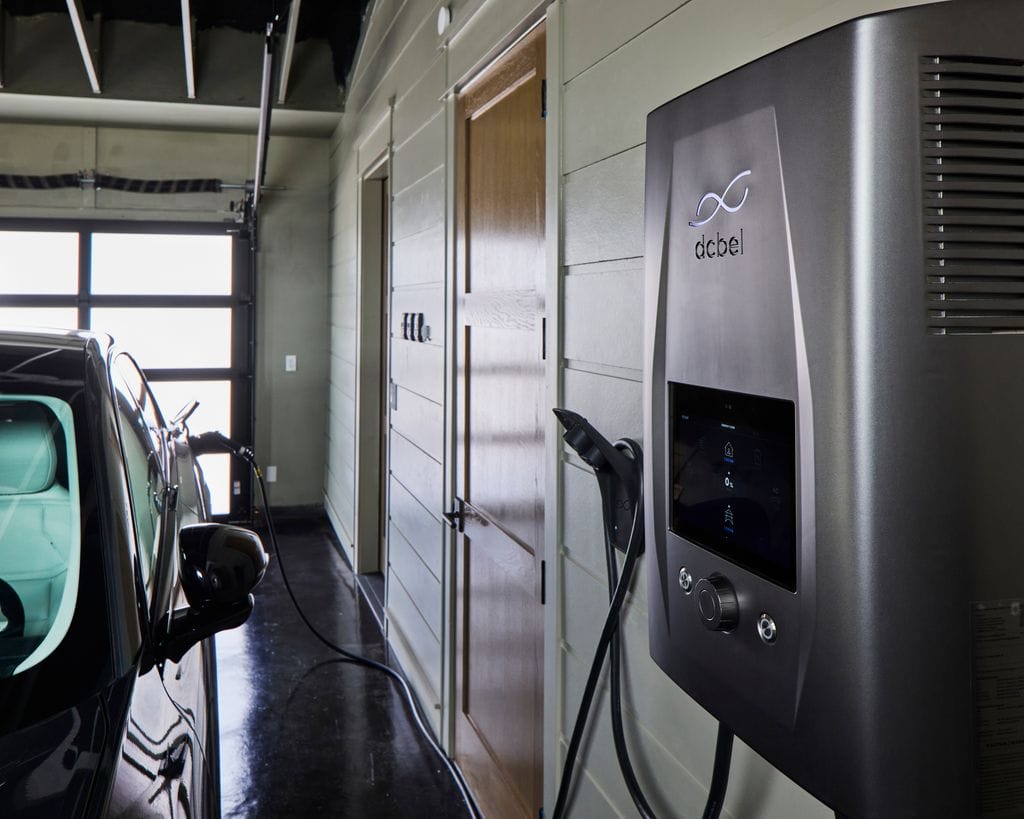
This is where dcbel’s approach matters. The Ara Home Energy Station is designed to bring the EV, the home, solar and the grid into one simple experience. Not so homeowners can manage more, but so they can manage less. Ara supports solar natively, so you can include solar from the beginning or add it later when you’re ready, without rebuilding the whole energy setup.
Your EV may be saying, “I’m ready.” The right home energy platform knows what to do next.